
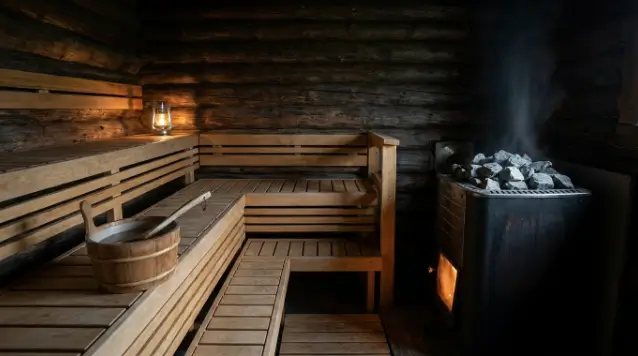

A traditional sauna built for cold-climate use needs a heater sized 10 to 20 percent above the standard chart, a well-insulated cabin with a vapor barrier behind the paneling, and a roof pitched to shed snow. Done right, a budget cedar cabin in the $4,000 to $6,500 range still reaches 170 to 190 degrees in 45 to 60 minutes even when it is well below freezing outside. The main cost difference between running a sauna in a cold climate and a mild one is a somewhat higher electric bill per session, not a fundamentally different build.
Why Does Cold Weather Change the Heater Math?
Heater sizing charts are typically built around a moderate temperature differential, and a cabin sitting outdoors in a region that regularly drops into the teens or single digits has to fight a much larger gap to reach the same 170 to 190 degree target. Most manufacturers recommend sizing up 10 to 20 percent from their standard chart for cold-climate installs, which for a 4×6 two-person cabin might mean stepping from a 6 kilowatt heater to a 7 or 8 kilowatt unit. Skipping this adjustment is the single most common reason a cold-climate sauna owner ends up disappointed, with a cabin that gets warm but never quite reaches the temperature that made the experience worthwhile in the first place.
Does Insulation Matter More in a Cold Climate?
It matters everywhere, but a poorly insulated cabin is far more forgiving in a mild climate than a cold one. A proper build uses a foil-faced vapor barrier directly behind the interior paneling, insulation in the wall cavity rated for the application, and weatherstripping around the door that actually seals rather than just looking sealed. In a cold climate, gaps that would be a minor inefficiency in a warm region turn into a heater that runs constantly and still loses the battle against outside air. Budget-focused buyers sometimes cut insulation quality to save money on the initial build, which tends to cost more over a winter in electricity than the insulation upgrade would have cost at purchase.
What Should the Roof and Foundation Handle?
A flat or very low-pitch roof that works fine in a dry climate can develop real stress after a winter of repeated heavy snowfall in a region that gets real accumulation. Checking that a cabin’s roof is rated for the local snow load, and has enough pitch to shed snow rather than hold it, is worth confirming before ordering rather than after the first big storm. The foundation matters too: frost heave can shift a gravel pad or deck-block foundation that was not set below the local frost line, so cold-climate builds often need a slightly deeper foundation prep than the same cabin would in a region with mild winters.
How Much More Does Winter Operation Actually Cost?
A heater working against a 20 degree outside temperature runs longer per session and cycles more often to hold steady heat than the same heater working against a 60 degree outside temperature. For a typical two-person cabin running a 20 to 30 minute session, the difference usually comes out to a matter of cents rather than dollars per session, since the heater is not running continuously the entire time even in cold weather. Over a full winter of regular use, several sessions a week, the added electricity cost is real but modest compared with the cost of a heater that was undersized to begin with and has to run constantly just trying to keep up.
See also: Understanding the Basics of Ethereum Blockchain
What Does Regular Use Add Up To Over a Cold Winter?
People in cold climates often use a sauna more consistently through the winter months than in summer, since it offers a specific kind of warmth that is harder to get elsewhere in the house. Research on regular sauna bathers, largely from Finnish cohorts where cold winters are the norm, has associated frequent use with favorable cardiovascular patterns and lower all-cause mortality compared with infrequent use, alongside measurable short-term effects on blood markers of cardiovascular function after a session. These are population-level associations rather than proof of an individual outcome, but they line up with why sauna culture took hold in cold-winter countries in the first place: a reliable source of intense heat during months when the outdoors offers none.
What Should a Budget Cold-Climate Build Prioritize?
With a fixed budget, the priority order for a cold climate is heater capacity first, insulation and vapor barrier second, roof and foundation third, and cosmetic upgrades last. A buyer comparing a basic cabin from a maker like Almost Heaven against a similarly priced listing from SweatDecks should specifically ask whether the heater size shown accounts for cold-climate sizing or reflects the standard chart, since that single spec determines more about winter satisfaction than wood species or exterior trim ever will. A slightly plainer cabin with the right heater and proper insulation outperforms a nicer-looking one that was speced for a mild climate.
What About the Path to the Cabin and the Door Itself?
An often-overlooked cold-climate detail is the walk from the house to the sauna. A gravel or paver path that turns to mud or ice in freeze-thaw cycles makes a five-second trip feel like a chore, which is a quiet way a sauna habit falls apart over a winter even when the cabin itself performs perfectly. A cleared, slightly graded path with good footing, and outdoor lighting if the sessions run into early darkness, keeps the routine easy enough to actually stick with. The door itself deserves attention too: a solid wood door with a full magnetic or compression seal holds heat far better through a cold winter than a lighter door built mainly for a mild-climate market, and the difference shows up directly in how long the heater has to run to recover the temperature lost each time the door opens.
Frequently Asked Questions
Does a sauna heater need to be bigger in a cold climate? Yes. Manufacturers typically recommend sizing up 10 to 20 percent above the standard chart for outdoor cabins in regions that regularly drop below freezing.
How long does an outdoor sauna take to heat up in winter? A correctly sized heater still reaches 170 to 190 degrees in roughly 45 to 60 minutes even in cold weather.
Does snow load affect a backyard sauna? Yes, a roof rated for local snow load with enough pitch to shed accumulation avoids stress that a flat or low-pitch roof can develop over a winter.
Is it more expensive to run a sauna in winter? Modestly. A heater working against colder outside air runs longer per session, adding a small amount to the electric bill compared with summer use.
References
- Association between sauna bathing and fatal cardiovascular and all-cause mortality events, JAMA Internal Medicine, 2015
- Joint associations of sauna bathing and cardiorespiratory fitness on cardiovascular and all-cause mortality risk: a long-term prospective cohort study, Annals of Medicine, 2018
- Short-term effects of Finnish sauna bathing on blood-based markers of cardiovascular function in non-naive sauna users, Heart and Vessels, 2018
By Colleen Traver
